

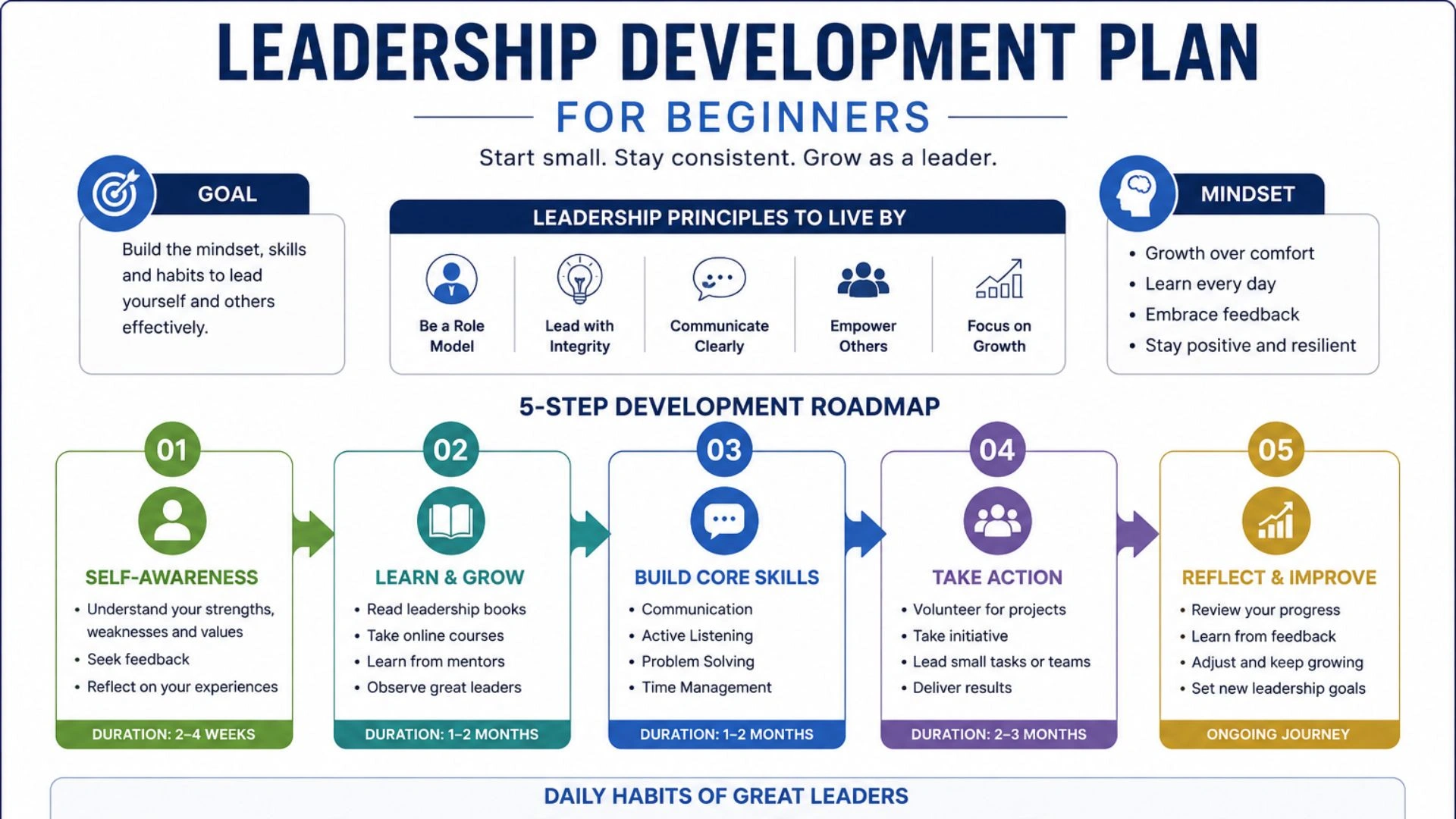
Leadership doesn’t start the day you get a manager title. It starts the moment people begin trusting you to make calls, solve problems, communicate clearly, and help others do their best work.
If you’re new to leading, that can feel like a lot. You might know your job inside and out and still have no idea how to run a team, deliver feedback, work through conflict, or make a decision when there’s no obviously right answer.
That’s exactly where a leadership development plan comes in.
A good plan gives you a practical, step-by-step way to build these skills instead of trying to become a polished leader overnight. You figure out what you actually need to work on, practice it on the job, ask people for honest feedback, and track how it’s going. This matters a lot in workplaces where people get promoted for being great at their job, then get little to no preparation for the actual people-management part of the role.
What Is a Leadership Development Plan, Exactly?
Think of it as a structured roadmap for building the knowledge, habits, and abilities you need to lead well.
For someone just starting out, the plan should zero in on a handful of foundational skills rather than trying to tackle everything at once. A workable plan usually covers:
- Clear leadership goals
- An honest look at current strengths and weaknesses
- The essential skills worth developing first
- Specific actions and practice opportunities
- Feedback from managers or colleagues
- Milestones you can actually measure
- A rough timeline for checking in on progress
It’s basically a personal training plan, except for leadership instead of fitness. You figure out where you stand today, decide where you want to be, and map out what you need to practice to close that gap.
Why Beginners Actually Need One
Getting promoted doesn’t automatically teach anyone how to lead.
A great salesperson becomes a sales manager. A skilled engineer becomes an engineering manager. A talented nurse, teacher, or project specialist eventually ends up supervising others. The technical skill that earned them the promotion is real and valuable but leading people calls for a different toolkit entirely.
Suddenly, a new manager has to figure out how to delegate work, resolve disagreements, give feedback that actually lands, keep people motivated, set priorities, manage performance, communicate expectations clearly, make hard calls, and coach people along the way.
Without any kind of plan, most new leaders end up learning all of this through trial and error — usually a lot more error than they’d like. A development plan just makes that learning process deliberate instead of accidental.
Step 1: Get Honest About Where You Stand
Before you can improve anything, you need a clear-eyed read on where you’re starting from. You don’t need a fancy assessment tool for this — a simple, honest self-review works fine.
Rate yourself from 1 to 5 across areas like:
- Communication
- Active listening
- Decision-making
- Delegation
- Conflict management
- Emotional intelligence
- Giving feedback
- Coaching
- Time management
- Strategic thinking
Then and this part matters: ask someone who actually works with you what they’d rate you. Self-perception and how others experience you can differ quite a bit.
For instance, you might rate your own communication a 5 because you explain tasks clearly. A colleague might point out that you rarely ask for input before making decisions. Neither of you is necessarily wrong it just reveals a blind spot worth paying attention to. That’s the whole point of doing this step.
Step 2: Pick One or Two Goals, Not Ten
One of the most common mistakes beginners make is trying to fix every leadership skill at the same time. Don’t do that. Pick one, maybe two, priorities.
Make the goal specific enough that you could actually measure it. Instead of something vague like “become a better leader,” try something more like: “Over the next 60 days, I’ll delegate at least one meaningful task to each team member and check in on it during our weekly one-on-ones.”
Or: “For the next eight weeks, I’ll ask at least one open-ended question before offering my own solution during coaching conversations.” Now you’ve got something you can actually track.
A quick framework that helps: make sure the goal is Specific, Measurable, Achievable, Relevant, and Time-bound (SMART). The simpler the goal, the more likely you are to actually stick with it.
Step 3: Build the Skills That Actually Come Up Every Day
You don’t need to master every leadership theory out there. Focus on the handful of skills that shape your everyday interactions with people.
- Communication: Leaders are constantly communicating goals, priorities, decisions, and feedback. Try cutting down on assumptions before wrapping up an important conversation, ask, “What questions do you have?” You can also have the other person repeat back the agreed next step in their own words. It’s a small habit that catches misunderstandings before they turn into real problems.
- Active listening: Listening is more than just staying quiet while someone else talks. Pay attention to what they’re actually saying, ask follow-up questions, and resist the urge to plan your response while they’re still mid-sentence. A simple habit: summarize what you heard back to them “If I’m hearing you right, your biggest concern is the deadline. Is that fair?” One sentence like that can prevent a surprising number of misunderstandings.
- Delegation: Delegating isn’t just handing someone a task and walking away. Explain what a good outcome looks like, give them the authority to actually make decisions, be clear about the deadline, and agree on how you’ll check in. Done well, it also gives people a real chance to grow their own skills.
- Decision-making: Leaders rarely get to work with perfect information. Build a repeatable process, define the problem, weigh your options, think through the risks, decide, then go back afterward and look at how it actually played out. Good leaders learn just as much from the decisions that didn’t go as planned.
- Emotional intelligence: This is about understanding your own reactions and picking up on what other people might be experiencing. Say an employee reacts badly to some feedback. A beginner might get defensive right away. A more seasoned leader pauses and asks, “What part of this feels hardest to hear?” That single question can turn a tense moment into a genuinely useful conversation.
Step 4: Learn to Give Feedback That People Can Actually Use
Feedback might be the single most important leadership skill, because people can’t improve on things they don’t know are a problem.
Skip vague lines like “you need to do better.” Instead, point to a specific behavior and its actual impact. Something like: “The client asked for the updated numbers today and we didn’t have them ready, which made it hard to answer their question. Let’s make sure the latest figures are part of our prep next time.” That gives someone an actual behavior to change.
Good feedback tends to be specific, timely, respectful, focused on behavior rather than character, tied to clear expectations, and followed by a real chance to improve. And it shouldn’t be saved up for an annual review short, regular conversations throughout the year tend to land much better.
Step 5: You Don’t Need a Title to Start Practicing
You can start building leadership skills long before anyone hands you a management title. Look for ways to lead from wherever you already are: volunteer to coordinate a project, mentor someone newer than you, run a team meeting, drive a process improvement, help sort out a workplace problem, own a project’s outcome, or offer to train colleagues on something you know well.
A quick example: imagine a marketing specialist who wants to move into a management role. Instead of waiting around for the promotion, she volunteers to coordinate a campaign that touches design, sales, and content teams. That project alone requires communication, delegation, scheduling, conflict resolution, and real decision-making. She’s building genuine leadership experience with no title required and that experience becomes solid evidence during her next performance review or job interview.
Step 6: Find Someone Who’s Already Done This
Learning from someone with more leadership miles under their belt can speed things up considerably. Your mentor doesn’t need to have followed the exact same career path, look for someone who models the qualities you’re trying to build.
A good mentor relationship can cover things like handling difficult workplace situations, career decisions, communication challenges, managing conflict, delegation, building trust, and navigating career progression.
Come to those conversations with specific questions, not vague ones. Instead of asking “how do I become a better leader,” try something like: “I have someone on my team who keeps missing deadlines. How would you approach that conversation?” Specific situations tend to get you much more useful advice than generic questions do.
Step 7: Actually Ask for Feedback (and Actually Listen to It)
Feedback is one of the fastest ways to spot your own blind spots.
Ask your manager: “What’s one leadership behavior I should work on strengthening over the next three months?” Ask colleagues: “What’s one thing I do that helps the team, and one thing I could do better?”
Don’t argue with what you hear, just listen. You don’t have to accept every piece of feedback as gospel, but if it keeps coming up, pay attention. If three different people independently mention that you interrupt too much in meetings, that’s probably worth examining rather than dismissing.
Step 8: Actually Track Whether Anything’s Changing
A development plan becomes far more useful once you’re actually measuring progress. A simple monthly check-in works well. Ask yourself:
- What did I practice this month?
- What actually changed? Look for real evidence, clearer meetings, more independent team members, conflicts getting resolved faster.
- What feedback did I get, and what stood out?
- What’s one lesson worth holding onto?
- What am I going to work on next?
Keep it in a notebook, a doc, a spreadsheet. The format matters way less than the habit itself.
A Simple 90-Day Plan to Get Started
If you want a concrete starting point, here’s a three-month framework.
- Days 1–30: Build self-awareness: Complete a self-assessment, ask two colleagues for honest feedback, identify two real strengths and two development areas, pick one primary goal, and start keeping a short leadership journal. The aim here is awareness, not perfection.
- Days 31–60: Practice: Turn your goal into actual behavior. If communication’s your focus, practice active listening deliberately. If delegation’s the weak spot, hand off one meaningful task each week. If feedback feels hard, schedule regular one-on-ones and use them. Track what actually happens.
- Days 61–90: Review and expand: Compare where you are now to where you started. Ask for feedback again. What’s improved? What still feels hard? What new challenge has surfaced? Then pick your next goal and keep the cycle going.
A Note on Learning From Books Too
Formal leadership training isn’t the only path here — books, mentoring, real workplace experience, and honest reflection all contribute plenty.
Leadership Lessons and You From A–Z by Stew Bolno lays out 26 leadership lessons in an A-to-Z format, drawing on Bolno’s experience leading teams, running executive seminars, coaching and mentoring, and teaching at the college level. For someone just starting out, that format offers an approachable way into different leadership ideas without diving into a dense textbook. You can find out more through Leadership Lessons and You and use the lessons as extra prompts for reflection alongside what you’re already practicing at work.
The point was never just to read about leadership — it’s to take one idea and actually try it out.
Mistakes Beginners Tend to Make
- Trying to fix everything at once: Leadership development takes time picking a small number of behaviors and building real consistency before adding more.
- Confusing authority with leadership: A title gives you responsibility. It doesn’t automatically earn you trust that’s built through consistent behavior over time.
- Avoiding hard conversations: Dodging a performance issue or conflict rarely makes it disappear. Learning to address it directly and respectfully is a skill worth building early.
- Doing everything yourself: New managers often skip delegating because it feels faster to just do it themselves. That habit eventually creates a bottleneck that only gets worse.
- Never asking for feedback: You can’t improve what you refuse to look at. Make it a normal, regular part of how you work.
How Do You Know It’s Actually Working?
Improvement is genuinely hard to notice from the inside. Look for real signals instead: employees start asking more questions, team members take more ownership, meetings get more productive, conflicts get addressed earlier rather than left to fester, delegated work needs less hand-holding, feedback conversations feel less awkward, people understand expectations more clearly, you’re making decisions with more confidence, and your own manager starts noticing the shift too.
The goal was never to feel like a totally different person. It’s just to become more effective than you were last month.
Conclusion
A leadership development plan for beginners doesn’t need to be complicated. Get honest about your current strengths and weaknesses. Pick one or two goals. Focus on the skills that actually shape your daily work. Practice them in real situations. Ask for honest feedback. Track what’s changing.
Above all, remember this is a process, not a destination. You don’t need a title to start leading you can lead through how you communicate, support the people around you, solve problems, take responsibility, and show up when things get hard.
Over time, those behaviors turn into habits. And those habits quietly become the kind of leader you turn out to be.
Pick one skill today. Practice it for the next 30 days. Then take a real look at what’s different. That’s usually all it takes to get a much stronger leadership journey moving.
Frequently Asked Questions
What does a good beginner leadership plan actually include?
Start with an honest self-assessment, pick one or two development goals, focus on foundational skills, build in regular practice and feedback, and measure your progress over a set period of time.
Which skills should beginners work on first?
Communication, active listening, emotional intelligence, decision-making, delegation, feedback, accountability, and conflict management are a solid foundation to start with.
Can I build leadership skills without being a manager?
Yes, absolutely. Mentoring colleagues, leading projects, coordinating teams, solving problems, running meetings, and owning outcomes all count — no formal title required.
How long does this actually take?
There’s no fixed timeline. Some individual behaviors shift within weeks of deliberate practice; broader development is an ongoing process. A 60- or 90-day cycle is a reasonable place to start.
What’s the single best way to get better?
Pick one behavior that matters right now in your role. Set a measurable goal, practice it consistently, ask for feedback, review what happened, then move to the next thing.
Also Read: How to Improve Leadership Skills