

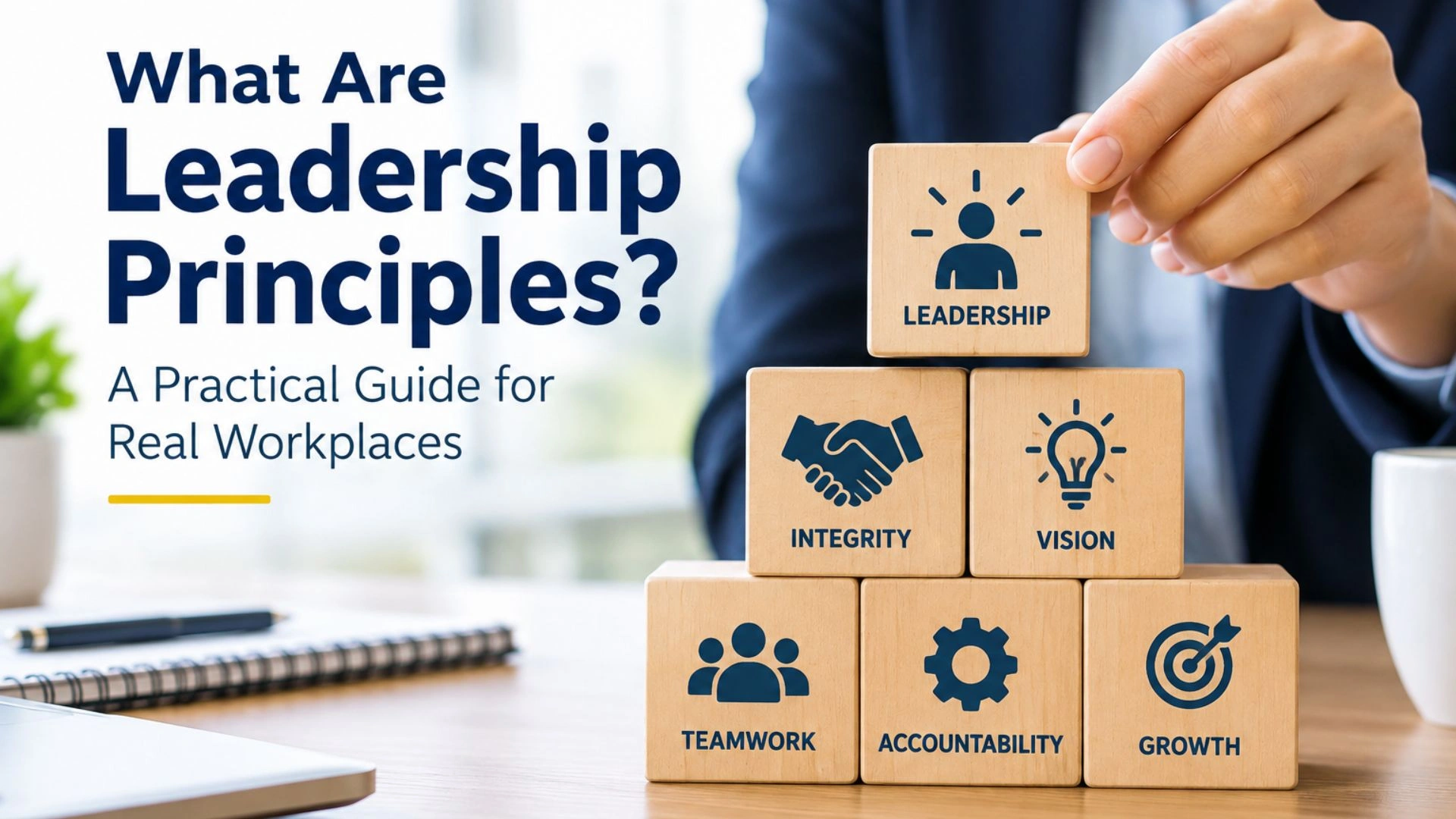
Most people can describe a good leader when they see one. Someone who’s calm under pressure, straight with you, willing to own a mistake instead of pointing fingers. What’s harder is explaining how that person got that way and that’s really where leadership principles come in.
They’re not slogans on a poster in the break room. They’re the handful of beliefs a leader actually falls back on when things get messy: a missed deadline, a tense conversation, a decision with no obviously right answer. Title and authority don’t create that kind of steadiness. Principles do.
This guide walks through what leadership principles actually are, why they matter more than most job descriptions admit, and ten of them worth building into your own habits whether you just got your first “manager” title or you’ve been running teams for twenty years.
What Exactly Are Leadership Principles?
Think of them as the operating rules underneath your behavior, the things you default to when you don’t have time to think it through from scratch.
Here’s a small example. A project falls behind schedule. A leader who genuinely values accountability doesn’t reach for blame first. They ask:
- What actually caused the delay?
- Is there something I should’ve caught earlier?
- What does the team need right now to get back on track?
- How do we keep this from happening again?
Nobody hands you those questions at the moment they come from having decided, ahead of time, that accountability matters more than looking good.
Some of the principles that show up again and again across good leaders, regardless of industry:
- Integrity
- Accountability
- Communication
- Empathy
- Respect
- Vision
- Adaptability
- Courage
- Continuous learning
- Developing others
You’ll find versions of this list at a five-person nonprofit and a Fortune 500 company alike. The context changes. The underlying instincts don’t.
Why Bother With Leadership Principles at All?
Because without them, leadership turns reactive. You end up making different calls in similar situations depending on your mood, the pressure you’re under that week, or who’s watching.
A manager juggling angry customers, an anxious exec, and a team that’s stretched thin doesn’t have the luxury of figuring out their values from scratch every time something goes sideways. Principles give you something to lean on instead.
Done well, they help you:
- Make decisions faster and with more confidence
- Earn trust instead of just demanding it
- Handle conflict without it turning personal
- Set expectations people can actually follow
- Hold people accountable without it feeling punitive
- Grow the next generation of leaders under you
- Adjust to change without losing your footing
- Shape a culture people actually want to work in
There’s real data behind this too. Gallup’s research has repeatedly tied manager quality to how engaged employees are and how well teams perform, with managers accounting for a notable chunk of the variation between teams. In plain terms: how you lead isn’t separate from your results. It is a big part of your results.
10 Leadership Principles Worth Building Into Your Routine
No single list is the “correct” one: different organizations, different seasons of business, different personalities will all emphasize different things. But these ten show up often enough, across enough contexts, that they’re a solid place to start.
1. Lead With Integrity
Integrity is doing the right thing even when it costs you something time, comfort, or looking good in the moment.
People notice the gap between what a leader says and what a leader does faster than leaders think. A manager who insists on punctuality but strolls in late twice a week is teaching their team something, just not what they intended.
In practice: when you make a mistake that affects the team, say so plainly. Instead of “the team missed the deadline,” try something closer to: “I should’ve flagged this risk sooner — let’s figure out what happened and what we change.” That one shift does more for your credibility than almost anything else on this list.
2. Practice Real Accountability
Accountability gets mistaken for blame-assignment all the time. It’s the opposite. It’s owning outcomes yours and the team’s and helping others learn to own theirs too.
Before assuming someone dropped the ball, ask:
- Was the goal actually clear going in?
- Did they have what they needed to succeed?
- What happened, specifically?
- What’s the lesson here?
- What needs to change going forward?
Accountability works best when expectations are clear before things went wrong, not invented after the fact to explain a failure.
3. Say What You Mean, Clearly
Vague instructions create more work than they save. “Improve this report” tells someone almost nothing useful. “Revise the report so the first section summarizes the three key findings, add the supporting data, and get it to me by Thursday” tells them exactly what done looks like.
Good communication isn’t just talking clearly it’s also:
- Actually listening
- Asking questions instead of assuming
- Giving feedback people can act on
- Explaining the “why” behind decisions
- Taking concerns seriously instead of brushing past them
- Checking that the message actually landed
Every bit of ambiguity you remove up front is a round of back-and-forth you don’t have to have later.
4. Build Trust the Slow Way — Through Consistency
Trust doesn’t come from one great team meeting or an inspiring speech. It’s built by doing, repeatedly, the things you said you’d do.
That means keeping commitments, being honest even when the news isn’t great, actually hearing people out, giving credit where it’s due, and dealing with problems head-on instead of letting them fester.
You don’t need to be flawless to earn people’s trust. You need to be predictable in the right ways.
5. Stop Treating People and Performance as a Trade-Off
There’s a version of leadership that pits “caring about people” against “caring about results,” as if you can only pick one. Good leaders know that’s a false choice sustainable results come from people who are supported, not squeezed.
Picture two managers watching their sales team miss a target. One just pushes harder: more calls, longer hours. The other starts asking questions: are the leads any good? Is the training actually working? Is the process itself broken somewhere? Are people getting coaching that helps?
The goal was never to lower the bar. It’s figuring out what’s actually standing between your team and clearing it.
6. Develop Leaders, Not Just Followers
If every decision has to run through you, you haven’t built a team, you’ve built a bottleneck.
The leaders worth learning from actively hand off responsibility, coach through it, and let people make mistakes that aren’t catastrophic. Instead of personally resolving every customer complaint, show someone on your team how to think through it themselves.
You’re not just clearing today’s inbox. You’re building tomorrow’s manager.
7. Lead With Empathy Without Losing Your Standards
Empathy gets a bad reputation among leaders who think it means going soft. It doesn’t. It means remembering that the person in front of you has a life, a history, and pressures you might not see.
You can hold someone to a high standard and ask what’s going on before assuming carelessness. Understanding someone’s situation and holding them accountable aren’t opposites, they usually work better together.
8. Have the Courage to Actually Decide
Leadership regularly puts you in the position of deciding without all the facts. Some of those calls will be uncomfortable delivering hard feedback, changing course on a plan people liked, saying no to something tempting, or admitting a strategy just isn’t working.
Ducking the decision doesn’t make the problem disappear. It usually just lets it grow. The job isn’t to have certainty, it’s to gather what information you can, weigh the risks honestly, and choose.
9. Stay Adaptable Without Losing Your Center
Conditions shift constantly technology, customer expectations, the market, the people on your team. Leaders who treat their process as sacred often struggle here. Leaders who treat their values as sacred adapt just fine.
A company moving from office-first to hybrid work has to rethink a lot about how it operates. What it shouldn’t have to rethink is whether it still values trust, accountability, and respect. Those hold steady while everything around them shifts.
10. Never Stop Learning
Even leaders with decades of experience run into situations they haven’t seen before. That’s not a failure, it’s just what leading looks like over time.
Learning happens through feedback, mentorship, books, tough experiences, honest conversations with your team, and just sitting with a decision afterward and asking what it taught you. That last question, what did this teach me that I can use next time is worth asking after nearly everything that goes sideways.
What This Actually Looks Like in Practice?
Principles are easy to nod along with. Applying them under pressure is the real test.
Take a manager we’ll call Sarah. Her team has now missed three deadlines in a row. Her gut reaction is to tighten the leash, more check-ins, daily status reports, closer monitoring. Predictably, the team gets more frustrated, not less.
So she steps back and tries something different. She actually listens first, and learns the project requirements kept shifting underneath the team without much warning. She clarifies who owns what, instead of leaving it fuzzy. She sets up a short weekly planning meeting so surprises get caught earlier. And she starts handing team members more responsibility for spotting risks themselves, instead of carrying that alone.
Nothing about this is a new “process” in any formal sense. It’s Sarah applying accountability, communication, and development deliberately, instead of by accident.
Leadership Principles vs. Leadership Skills
People use these two terms interchangeably, but they’re not quite the same thing. Principles are the beliefs steering your behavior. Leadership Skills are what let you actually put those beliefs into action.
| Leadership Principle | Leadership Skill |
| Integrity | Ethical decision-making |
| Communication | Active listening |
| Accountability | Performance management |
| Empathy | Emotional intelligence |
| Developing others | Coaching |
| Adaptability | Change management |
| Courage | Difficult conversations |
You can believe deeply in accountability and still fumble the actual conversation where you hold someone to it. That’s why real leadership development has to work on both fronts: what you believe, and what you’re actually capable of doing with it.
How to Actually Apply This Without Overhauling Everything at Once?
You don’t need to rebuild your entire leadership style this week. Pick one thing and start there.
- Step 1: Pick one principle: Say it’s communication.
- Step 2: Be honest about where you stand now: What are you currently doing that helps communication? What’s quietly hurting it?
- Step 3: Choose one specific new behavior: Not five. One. Something like: “I’ll spend the first five minutes of every one-on-one just listening before I offer advice.”
- Step 4: Ask people directly: “Is there anything I could be doing differently to make communication easier?” Then actually listen to the answer.
- Step 5: Check in with yourself a month later: What got better? What didn’t move at all? What did you learn that you’d do differently next time?
Small, consistent changes beat sweeping ones that fade out after two weeks.
For New Managers Specifically
A lot of new managers assume the promotion means they’re now supposed to have every answer. They’re not. The job just changed from being mostly responsible for your own output to being responsible for helping other people do theirs well.
Worth focusing on early:
- Set expectations clearly, up front
- Listen before you react
- Give feedback while it’s still timely, not months later
- Resist the urge to micromanage
- Actually recognize good work when you see it
- Catch problems early instead of letting them compound
- Learn how each person on your team actually works best
- Build decision-making skill in your team, not just in yourself
That last one delegating real ownership is usually the hardest transition. If you keep doing every important task yourself, your team never gets the chance to grow into the people you’ll eventually need them to be.
How Leadership Principles Shape a Company’s Culture?
Culture isn’t what’s written in the values statement. It’s what leaders consistently reward, tolerate, or shut down.
If a company claims to value collaboration but keeps promoting the person who elbows everyone else out of the way, people notice and adjust their behavior accordingly. If leaders say mistakes are safe to talk about but quietly punish anyone who admits one, people stop admitting them.
Values only mean something when they show up in the unglamorous, everyday stuff: how meetings run, who gets promoted, how feedback actually gets delivered, how conflict gets resolved.
The Bottom Line
None of this is a complicated theory. Leadership principles are just practical standards for how you show up when things get hard.
A leader who values integrity tells the truth, even when it’s inconvenient. One who values accountability owns outcomes instead of assigning blame. One who values empathy listens before judging. One who values development spends real energy making other people more capable.
Nobody’s chasing perfect leadership here. The goal is to be more intentional, pick a principle, turn it into a behavior you actually practice, ask people how it’s landing, and build from there.
Leadership Lesson & You Naturally can help readers continue that journey by exploring practical leadership lessons, leadership development ideas, and real-world approaches to becoming a more effective leader.
Ready to strengthen your leadership approach? Start with one principle today and turn it into a behavior your team can experience.
FAQ
What are leadership principles?
They’re the core beliefs and standards that shape how a leader behaves, communicates, decides, and treats people things like integrity, accountability, communication, empathy, courage, and a willingness to keep learning.
What are the five most important leadership principles?
If you had to narrow it down: integrity, accountability, communication, empathy, and developing others. That said, the right emphasis really does shift depending on the leader, the organization, and what’s happening at the time.
Why do leadership principles matter?
They give leaders a consistent way to make decisions and treat people, instead of reinventing their approach every time something new happens. Over time, that consistency is what builds trust and stronger teams.
How do you actually apply leadership principles?
Pick one, connect it to a specific, small behavior, put it into practice, ask for honest feedback, and check your progress after a set period. Repeat with the next one.
Can leadership principles be learned, or are some people just born with them?
Learned, mostly. Experience, feedback, coaching, deliberate practice, and honest reflection on what worked and what didn’t that’s how most good leaders actually got that way.
Also Read: Leadership Importance