

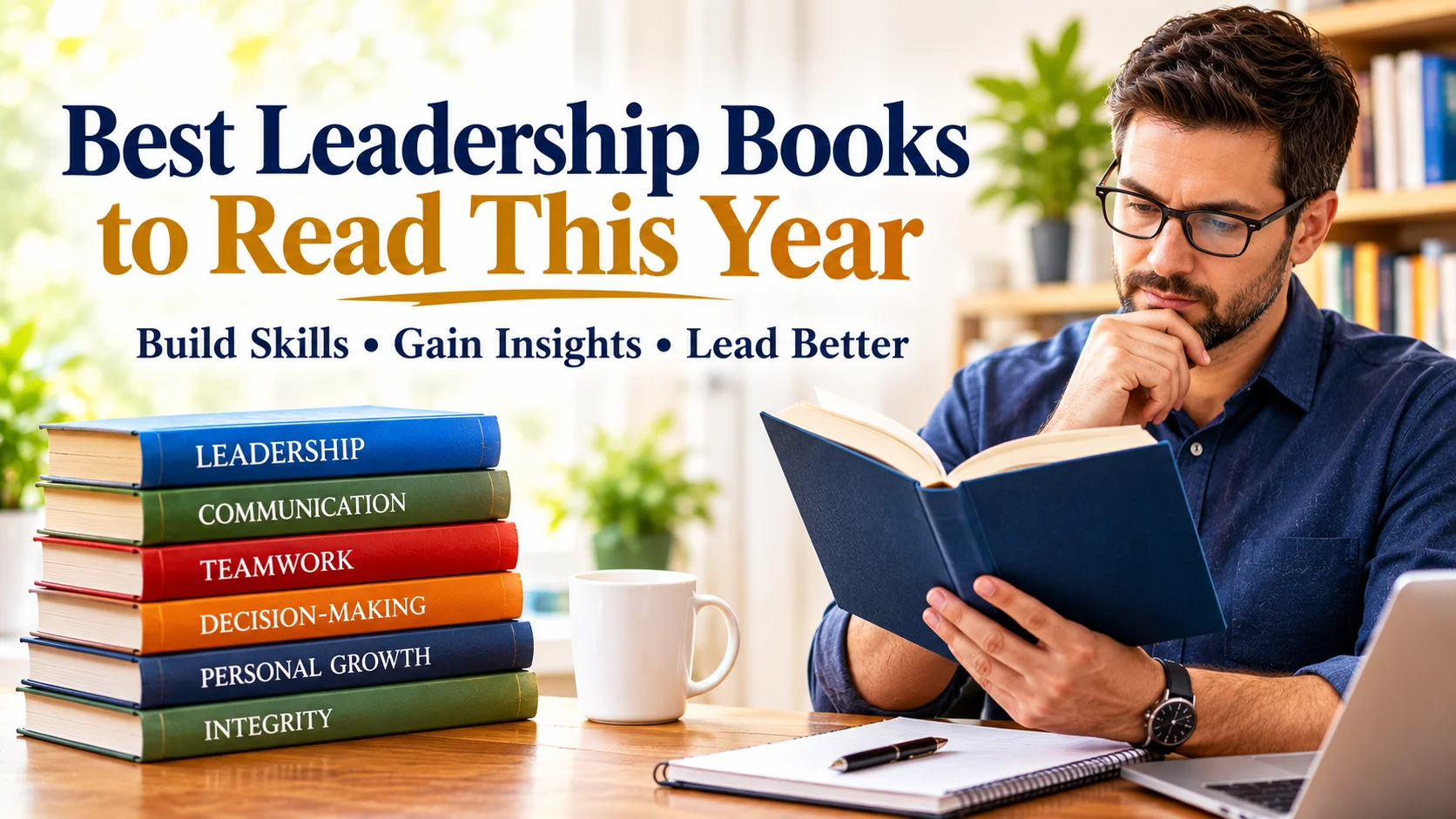
Leadership is not something you master by receiving a job title. It develops through experience, self-awareness, good decisions and the ability to bring out the best in other people. Whether you manage a large team, run a small business or are preparing for your first leadership role, the right books can help you develop these skills.
However, with thousands of leadership books available, choosing where to begin can be difficult. Some focus on building confidence. Others explain how to manage teams, communicate clearly, resolve conflict or make better decisions.
This guide explores 11 leadership books worth considering in 2026. It includes a featured recommendation from Leadership Lessons and You, along with established titles that offer practical insights into leadership, communication, teamwork and personal development.
What Are the Best Leadership Books to Read in 2026?
The best leadership books depend on the skills you want to develop. Our featured pick is Leadership Lessons and You: From A–Z by Stew Bolno, which presents 26 leadership lessons in an accessible alphabetical format. Other worthwhile choices include Atomic Habits, Dare to Lead, Hidden Potential, The Five Dysfunctions of a Team and The 7 Habits of Highly Effective People.
1. Leadership Lessons and You: From A–Z by Stew Bolno
Featured Pick | Best for: Practical leadership lessons, personal development and self-leadership.
Leadership development does not always require complicated theories or lengthy management frameworks. Sometimes the most useful lessons are the ones that help you reflect on your everyday decisions, behavior and relationships.
Leadership Lessons and You: From A–Z by Stew Bolno takes a straightforward approach to leadership development. The book is organized around 26 leadership lessons, with each letter introducing a particular leadership concept, value, attitude or behavior.
Rather than simply presenting ideas to memorize, the book encourages readers to think about how each lesson applies to their own personal and professional lives. Its format is designed to help readers reflect, consider examples of leadership in public life and develop an action plan for applying what they learn.
Some of the leadership topics explored include:
- Determination: Staying committed when challenges arise.
- Goal orientation: Keeping attention on meaningful objectives.
- Integrity: Acting according to strong personal and professional values.
- Patience: Understanding that good results often require time and persistence.
- Street smarts: Using practical judgment when facing real-world situations.
- Wisdom: Learning from experience and making thoughtful choices.
The book is intended for aspiring leaders, experienced professionals, young adults starting their careers and people interested in leading themselves more effectively.
One useful way to approach it is to read one lesson at a time. After reading, consider three questions:
- Where have I demonstrated this leadership quality?
- How could I use it more effectively in my current role?
- What specific action can I take this week?
This makes the reading experience more practical. Instead of finishing a book and forgetting its ideas, you can connect each lesson to a real situation.
Who should read it? Anyone looking for an accessible introduction to leadership principles, self-awareness and personal responsibility.
You can explore the book, review sample pages and see the available formats on the official Leadership Lessons and You: From A–Z book page.
Editorial disclosure: Leadership Lessons and You is published by the platform that offers this featured book. It is placed first as the publication’s featured recommendation, not as an independently verified bestseller ranking.
2. Inviting Genius by Matthew Abrams
Best for: Teamwork, conflict resolution and better conversations.
Healthy disagreement is an important part of effective leadership. When employees are afraid to challenge ideas, teams can miss valuable insights and make weaker decisions.
In Inviting Genius: How Good Leaders Use Conflict to Become Great, Matthew Abrams explores how leaders can use tension and disagreement to improve team performance. Rather than treating every disagreement as a problem, the book encourages leaders to create an environment where people can discuss difficult issues constructively.
For example, imagine a marketing team that disagrees about its next campaign. A manager who shuts down discussion may miss useful ideas. A leader who invites different viewpoints can help the team examine the evidence and make a stronger decision.
This book is particularly useful for managers who want to improve collaboration without avoiding difficult conversations.
3. Humble Power by Ethan Willis
Best for: Humility, trust and authentic leadership.
Some people assume that effective leaders must always appear confident and have every answer. In reality, strong leadership often starts with recognizing what you do not know.
Humble Power by Ethan Willis explores how humility can strengthen influence and relationships. The book highlights how leaders can build credibility by admitting mistakes, listening carefully and remaining open to feedback.
Consider a business owner whose new strategy fails to deliver expected results. Instead of blaming employees, the owner reviews the evidence, accepts responsibility and invites the team to suggest improvements.
4. Atomic Habits by James Clear
Best for: Personal discipline, consistency and daily improvement.
Leadership development does not always require major changes. Small actions repeated consistently can have a meaningful impact over time.
In Atomic Habits, James Clear explains how everyday habits shape long-term behavior. Although the book is not exclusively about leadership, its ideas are highly relevant to anyone responsible for guiding others.
A manager could apply its lessons by reviewing priorities before starting the workday, preparing for important meetings, setting aside time for employee feedback and reviewing progress at the end of every week.
The book also teaches an important lesson for managing teams: do not rely only on motivation. Build systems that make good work easier to repeat.
5. Hidden Potential by Adam Grant
Best for: Growth mindset, learning and developing employees.
A person’s current performance does not always reveal what they are capable of achieving. Effective leaders understand that people can develop new skills when they receive the right opportunities, support and feedback.
In Hidden Potential, organizational psychologist Adam Grant examines how character, learning and supportive environments can help people reach higher levels of performance.
For example, an employee who struggles with public speaking may become a confident presenter through practice, coaching and gradually taking on challenging assignments.
Leaders can apply this lesson by giving employees opportunities to learn instead of assuming they are limited by their current abilities.
6. Dare to Lead by Brené Brown
Best for: Courage, trust and honest communication.
Leadership often requires difficult conversations. Managers must sometimes provide uncomfortable feedback, acknowledge mistakes or discuss problems that employees would rather avoid.
In Dare to Lead, Brené Brown focuses on courage, vulnerability, empathy and trust. The book challenges the idea that leaders must hide uncertainty or avoid showing emotion.
A manager who needs to address declining performance can arrange a private conversation, explain the concern and listen to the employee’s perspective. This approach combines honesty with respect.
7. The 7 Habits of Highly Effective People by Stephen R. Covey
Best for: Personal effectiveness, priorities and responsible decision-making.
First published in 1989, The 7 Habits of Highly Effective People remains one of the best leadership books of all time.
Stephen R. Covey explains how personal responsibility, clear priorities and strong relationships contribute to lasting effectiveness.
One of its most useful ideas is to focus on what matters instead of spending the entire day reacting to urgent requests. A manager can apply this by protecting time for employee development, planning and important long-term responsibilities.
8. The Five Dysfunctions of a Team by Patrick Lencioni
Best for: Team management, trust and accountability.
A talented group of employees does not automatically become a successful team. People need trust, open communication and a shared understanding of their responsibilities.
In The Five Dysfunctions of a Team, Patrick Lencioni uses a business fable to explore five connected challenges:
- Absence of trust.
- Fear of conflict.
- Lack of commitment.
- Avoidance of accountability.
- Inattention to team results.
9. Radical Candor by Kim Scott
Best for: Feedback, management communication and employee development.
Giving feedback is one of the most important responsibilities of a leader. Yet many managers struggle to balance honesty with empathy.
Radical Candor by Kim Scott presents an approach based on caring personally while challenging directly. The goal is to help employees understand where they can improve without making them feel disrespected.
A manager who notices repeated late reports should explain the issue clearly, ask about possible obstacles and agree on a practical improvement plan.
10. The Effective Executive by Peter F. Drucker
Best for: Productivity, time management and decision-making.
Leadership involves more than managing people. It also requires using time wisely, identifying priorities and making decisions that move an organization forward.
In The Effective Executive, Peter F. Drucker explains how knowledge workers and managers can become more effective through disciplined practices.
The book explores time management, contribution, strengths, priorities and decision-making. It is a valuable choice for executives, entrepreneurs and professionals who want to improve their effectiveness.
11. Extreme Ownership by Jocko Willink and Leif Babin
Best for: Accountability, responsibility and team performance.
Leaders are responsible for creating clarity, setting expectations and addressing problems when things go wrong.
In Extreme Ownership, former Navy SEAL officers Jocko Willink and Leif Babin explain principles of responsibility and leadership developed through their military experiences.
One of the book’s central ideas is that leaders should examine their own decisions and actions before blaming others.
Imagine a project that misses its deadline because responsibilities were unclear. A more effective response is to examine whether expectations were communicated properly and whether employees had the resources they needed.
This book is especially useful for leaders who want to strengthen accountability and improve execution.
What Makes These the Best Leadership Books?
There is no single ranking that determines which leadership book is best for everyone. A useful reading list should cover different skills and leadership challenges.
Sales rankings provide one way to identify books attracting readers. However, popularity does not automatically mean a book is the right fit for your situation. A manager struggling with employee communication may benefit more from Radical Candor than from a book focused mainly on personal productivity.
The best leadership books are those that help you understand a challenge and take practical steps to improve.
Why Reading Leadership Books Matters in 2026
The workplace continues to change. Managers must support employees, respond to new technology, communicate across different working arrangements and make decisions in uncertain conditions.
Gallup’s State of the Global Workplace 2026 report found that global employee engagement declined to 20% in 2025. It also reported that global manager engagement fell from 31% in 2022 to 22% in 2025.
These figures highlight an important challenge. Organizations need capable managers who can support both performance and employee experience.
Reading alone cannot solve workplace problems. However, leadership books can introduce useful frameworks and encourage managers to examine their behavior.
A leader who reads about communication can improve one-to-one conversations. Someone studying decision-making can learn to evaluate options more carefully. A manager exploring team development can discover better ways to delegate and coach.
How to Get the Most Value From Leadership Books?
Reading several books without changing your behavior will produce limited results. Instead, use a practical approach:
- Identify one leadership challenge: Decide whether you need to improve communication, confidence, time management, teamwork or decision-making.
- Choose a book that addresses that challenge: Avoid selecting books only because they are popular.
- Take notes while reading: Write down useful ideas, questions and examples that relate to your work.
- Apply one lesson at a time: For example, practice giving clearer feedback during your next employee meeting.
- Review your progress: Ask whether the new behavior improved communication, productivity or team relationships.
Conclusion
The best leadership books do more than share inspiring ideas. They help you recognize challenges, understand people and make better decisions in everyday situations.
Whether you start with Leadership Lessons and You: From A–Z to explore 26 leadership concepts, Dare to Lead to build trust or The Effective Executive to manage your priorities, focus on lessons you can apply immediately.
Start with one book that addresses your biggest leadership challenge. Put its ideas into practice and reflect on the results. Over time, consistent learning and action can help you become a more capable, thoughtful and effective leader.
Explore more practical leadership insights through Leadership Lessons and You and continue building the skills that make a lasting difference.
Frequently Asked Questions
What are the best leadership books for beginners?
Leadership Lessons and You: From A–Z by Stew Bolno is one option for readers looking for an accessible introduction to 26 leadership lessons. Other useful starting points include The 7 Habits of Highly Effective People by Stephen R. Covey and Atomic Habits by James Clear.
What are the best leadership books of all time?
Popular long-standing choices include The 7 Habits of Highly Effective People, The Effective Executive, Good to Great, The Five Dysfunctions of a Team and Leaders Eat Last. Each explores a different aspect of leadership, from personal effectiveness to team culture.
What are the best-selling leadership books?
Bestseller rankings change over time. Sales-based lists from publishers and booksellers can help identify popular titles, but readers should also consider the book’s relevance to their own leadership goals.
Can reading leadership books make me a better leader?
Yes, when you apply what you learn. Leadership books can help you understand management principles, improve communication and develop better habits. However, real improvement also requires practice, feedback and experience.
Also Read: Top 10 Common Leadership Mistakes