

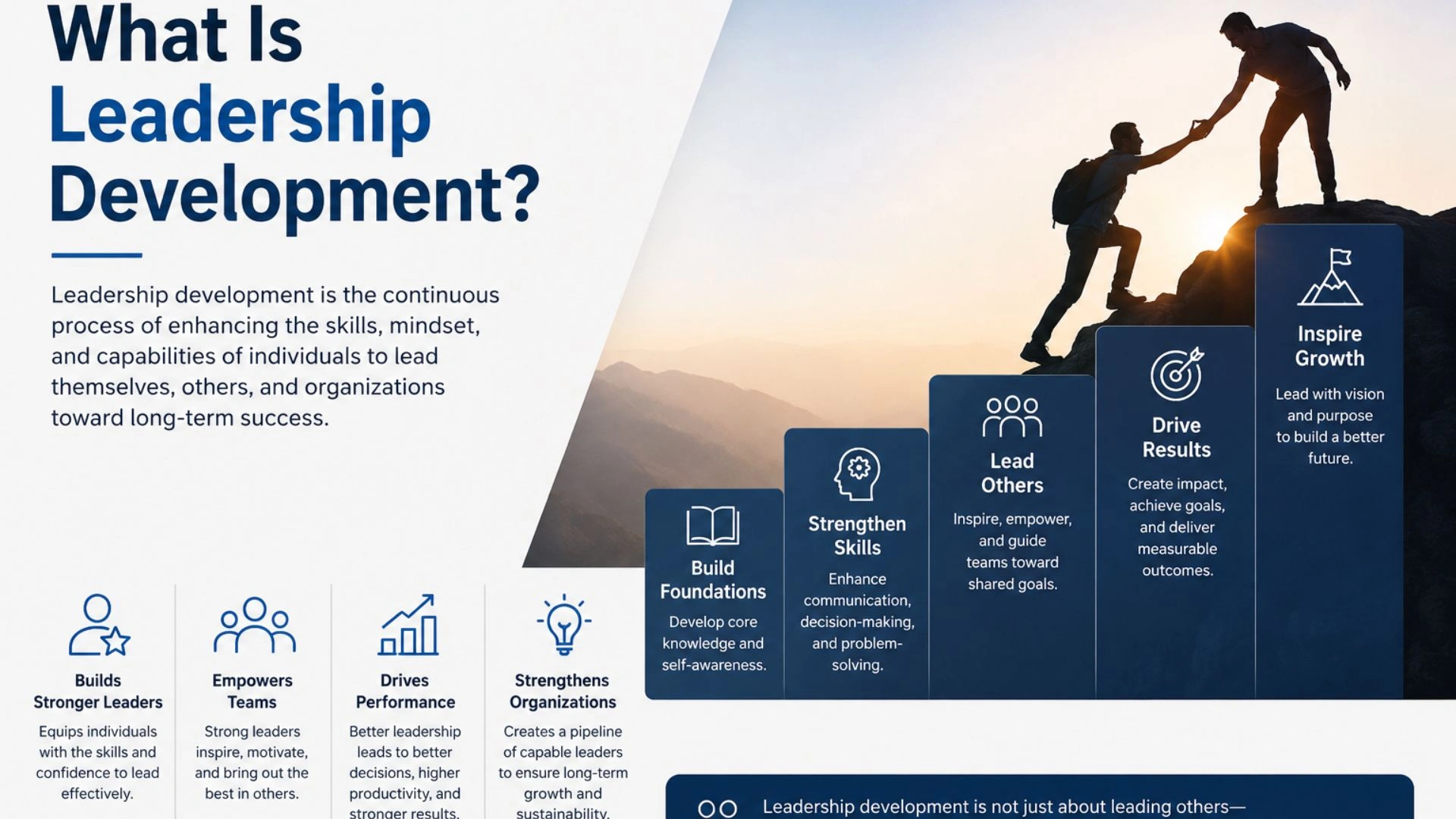
along in the small decisions someone makes, how they communicate, how much responsibility they’re willing to own, and how they act when things get hard.
That’s part of why leadership development matters for way more people than just executives. Someone gearing up for their first promotion, a brand-new manager figuring out how to run a team, a founder building a company from scratch, a seasoned professional who wants to sharpen their edge all of them stand to gain from it.
So what does leadership development actually mean in practice?
At its core, it’s the ongoing work of building the knowledge, habits, mindset, and practical skills that let you lead yourself and other people well. That can touch communication, decision-making, emotional intelligence, accountability, strategic thinking, conflict resolution, and the ability to grow the people around you.
And it doesn’t have to come from a formal program. Books, mentors, coaching, on-the-job experience, honest feedback, quiet reflection, deliberate practice all of it counts. If you’re trying to become a better leader, the formula is pretty simple: learn something useful, try it out in a real situation, think about how it went, and keep going.
Defining Leadership Development
Leadership development is the intentional work of building the capabilities that help someone lead well. That list usually includes things like:
- Communication
- Decision-making
- Emotional intelligence
- Accountability
- Problem-solving
- Strategic thinking
- Conflict resolution
- Delegation
- Self-awareness
- Adaptability
- Team building
- Coaching and mentoring
It’s worth separating this from plain management training. Management tends to focus on planning, organizing, budgets, processes, and performance tracking. Leadership pulls in more than that influence, relationships, judgment, character, and the ability to get people moving toward something they actually believe in.
A manager can tell a team what needs doing. A leader also explains why it matters, clears obstacles out of the way, actually listens to concerns, and sets people up to succeed. That difference starts to matter a lot more as someone takes on bigger responsibilities.
Why Bother With Leadership Development?
The workplace keeps shifting under everyone’s feet. Technology is reshaping jobs. Teams are more flexible than they used to be. Employees expect more communication and more investment from the people managing them. And leaders are constantly being asked to decide things without having all the information they’d like.
That gap says a lot. Leadership development can’t just be something that kicks in after someone reaches the executive suite. People need real chances to build these leadership skills before and during the transitions that matter most.
Done well, it can help people:
- Communicate more clearly
- Make sharper decisions
- Build real trust
- Navigate hard conversations
- Handle conflict without dread
- Grow their confidence
- Motivate and support the people around them
- Adjust when things change
- Take on more responsibility with less anxiety
- Get ready for whatever leadership role comes next
It also helps organizations avoid a common trap: promoting someone because they’re great at their job, then just hoping they figure out how to lead.
Leadership Skills That Actually Matter
There’s no universal checklist that guarantees leadership success. Different situations call for different strengths. Still, a handful of skills show up again and again, across industries and roles.
1. Communication
Good leaders communicate clearly, and that’s about more than being a confident speaker. It includes listening, asking the right questions, setting clear expectations, giving useful feedback, and adjusting your message depending on who’s in front of you.
Take a manager who tells someone, “You need to do better.” The employee walks away without any real idea of what to change. A better version of that conversation lays out what happened, why it matters, what improvement actually looks like, what support is available, and when they’ll check back in. That kind of clarity cuts out a lot of unnecessary confusion.
Listening carries just as much weight. Employees often see customer issues, process breakdowns, everyday friction that leaders never encounter directly. A leader who actually listens has access to information they’d otherwise miss entirely.
2. Self-Awareness
Understanding yourself might be the single most underrated leadership skill there is. That means being honest with yourself about your strengths, your weaknesses, what sets you off emotionally, your communication quirks, your values, your blind spots, and how you land on other people.
Picture a manager who gets defensive the moment someone disagrees with them. Without self-awareness, they’ll probably decide the employee is just being difficult. With it, they can catch themselves and ask, “Why am I reacting this way?” That small pause is the difference between reacting on autopilot and actually responding.
Leadership really does start with leading yourself. It’s hard to consistently guide other people well if you don’t understand how your own behavior affects them.
3. Decision-Making
Leading means deciding things some small, some big enough to affect employees, customers, budgets, or the direction of the whole organization.
Good decision-making isn’t about having perfect information (nobody ever does). It’s more about developing a workable process: define the problem, gather what actually matters, weigh realistic options, think through the risks, make the call, watch what happens, and adjust if circumstances shift.
That last step trips people up sometimes. Changing course after new information comes in isn’t a sign of weakness, it’s often a sign of good judgment.
4. Emotional Intelligence
Leadership is fundamentally about people, and people show up to work with emotions attached. Emotional intelligence is what lets a leader notice those emotions and respond thoughtfully instead of ignoring them.
Say an employee goes quiet during a team meeting. A manager focused purely on output might not even register it. A leader with sharper emotional awareness checks in privately afterward to see if something’s going on.
None of this means agreeing with everyone all the time. It means understanding people well enough to respond in a way that actually fits the moment, managing your own stress, working through disagreements, building real relationships, listening with some empathy, keeping your own reactions in check, delivering hard feedback without cruelty, and creating an environment where people feel safe enough to speak up.
5. Accountability
When something goes sideways, leaders face a choice. They can go hunting for someone to blame, or they can ask: what actually happened, what was my part in it, and what do we do now?
Accountability doesn’t mean shouldering blame for everything that happens on your watch. It means owning your own decisions and responsibilities and expecting the same from everyone else.
6. Adaptability
Change shows up whether anyone invites it or not. New technology reshapes how a team works. A company restructures overnight. A customer’s expectations shift. A project loses half its resources without warning.
Leaders who can’t adjust end up becoming the obstacle their own team has to work around. Adaptability means staying open to new information, being willing to change your approach, questioning old assumptions, experimenting with better methods, and helping other people get through uncertainty without losing their footing.
It’s worth saying: staying adaptable doesn’t mean abandoning your principles. Your values can hold steady even while your methods keep evolving.
7. Growing Other People
One of the clearest markers of leadership maturity is whether someone can actually help other people get better. A leader shouldn’t be the one solving every single problem. The real work is developing people who can eventually solve those problems on their own.
That looks like handing off meaningful responsibility, giving feedback that’s actually useful, coaching instead of just correcting, creating chances to learn, recognizing real improvement, encouraging people to think for themselves, and quietly preparing the next generation of leaders.
Gallup’s 2025 workplace research found that managers who got training focused on coaching and people development saw team engagement rise by as much as 18%, with manager performance metrics improving somewhere between 20% and 28%.The takeaway is worth sitting with: leadership development shouldn’t just sharpen the leader. It should make the people around them better too.
How the Development Process Actually Works
Leadership development sticks when the learning connects to real behavior, not just theory. A simple cycle looks like this:
Learn → Practice → Reflect → Get Feedback → Adjust → Repeat
Say you want to get better at communication.
- Learn: Study up on active listening and clear communication.
- Practice: Try those techniques out in your next team meeting.
- Reflect: Think honestly about what landed and what didn’t.
- Get feedback: Ask someone you trust how it actually came across.
- Adjust: Pick one specific thing to work on.
- Repeat: Do it again, and keep refining.
Run that loop enough times and leadership development stops being an event and starts being a habit.
For New Managers Specifically
Moving from individual contributor to manager is a genuinely hard shift. Getting promoted usually means you were excellent at your old job; it doesn’t automatically mean you know how to manage people.
Suddenly there’s a whole new skill set to build: delegating, giving feedback, handling conflict, setting clear expectations, having tough conversations, keeping people motivated, prioritizing across a team instead of just your own work, and making calls that affect other people’s careers.
That’s exactly why new managers benefit from starting leadership development early. Five areas are worth focusing on first:
- Know yourself: Your strengths, blind spots, and habits as a leader.
- Know your team: How each person communicates, works, and wants to grow.
- Set expectations: Make responsibilities and outcomes genuinely clear.
- Communicate consistently: Don’t wait until something’s gone wrong to talk.
- Ask for feedback: Find out directly what your team actually needs from you.
The jump from employee to manager gets a lot smoother once leadership is treated as a skill worth building, not a role you’re just supposed to perform.
It’s Not Just for Executives
A common myth: leadership development is mostly for CEOs and senior leaders. It’s really not.
These skills are useful for students, employees, brand-new managers, founders, business owners, project leads, community organizers, and yes, seasoned executives too.
You don’t need direct reports to demonstrate leadership. An employee who takes initiative, jumps in to solve problems, communicates responsibly, and looks out for their colleagues is already showing leadership behavior — with or without a title.
That’s also why these skills matter well beyond work. The ability to communicate clearly, manage your own reactions, make sound decisions, solve problems, and take responsibility carries over into relationships outside the office too.
Books as a Development Tool
Formal training is just one path into leadership development. Books are another.
A solid leadership book can hand you new perspectives, useful principles, real-world examples, practical lessons, and better questions to sit with. Readers interested in this route might check out Leadership Lessons and You: From A–Z by Stew Bolno, which works through leadership ideas in an A-to-Z format.
The real value isn’t in collecting a pile of leadership ideas, though, it’s in actually asking how those ideas apply to your own decisions, relationships, and day-to-day responsibilities. You can find more essays and perspectives at Leadership Lessons and You.
Building Your Own 30-Day Plan
You don’t need an elaborate program to get started. Try something simple.
Week 1: Self-awareness: Name three leadership strengths and two behaviors you’d like to change.
Week 2: Communication: Focus on listening before you respond. In at least one important conversation, ask a genuine follow-up question instead of jumping straight to your answer.
Week 3: Accountability: When something goes wrong, figure out your own role in it before you talk about anyone else’s.
Week 4: Feedback: Ask a colleague or team member, “What’s one thing I could do differently that would make me a better leader?” Don’t defend yourself just listen. Then decide what you’re actually willing to change.
At the end of the month, take stock of where you landed and pick the next skill to work on. That’s really all leadership development is when you strip away the jargon.
Final Thoughts
Leadership development isn’t a finish line, it’s an ongoing loop of learning, practicing, reflecting, and adjusting.
The strongest leaders aren’t necessarily the ones who’ve read the most leadership theory. They’re the ones who actually turn what they learn into different behavior. They communicate clearly. They listen. They own their mistakes. They think before they decide. They stay flexible when the ground shifts. And they spend real energy developing the people around them, all while continuing to learn from their own experience.
If you’re just starting out, don’t try to fix everything at once. Pick one skill. Practice it this week. Ask someone for honest feedback. Then work on it a little more.
Over time, those small adjustments turn into habits. Those habits shape how you lead. And how you lead shapes the people and organizations around you.
If you want to keep exploring these ideas, Leadership Lessons and You: From A–Z is another resource worth a look at, a place to reflect on leadership principles and think through how they apply to your own situation.
Leadership development starts with learning. It becomes real the moment you put that learning into action.
Frequently Asked Questions
What is leadership development?
It’s the ongoing process of building the knowledge, behaviors, mindset, and skills needed to lead yourself and others well covering things like communication, decision-making, emotional intelligence, accountability, strategic thinking, and developing the people around you.
Why does it matter?
It helps people get ready for bigger responsibility and get better at communicating, deciding, handling hard moments, building trust, and supporting others along the way.
What are the core leadership skills?
Communication, self-awareness, emotional intelligence, accountability, decision-making, adaptability, problem-solving, delegation, and the ability to develop other people.
Can leadership actually be learned?
Yes. It comes through education, practice, feedback, mentoring, coaching, reading, real workplace experience, and honest reflection. You don’t need to be naturally confident or charismatic to become a genuinely good leader.
Where should I start?
Pick one skill: communication, accountability, self-awareness, whatever feels most relevant right now. Learn about it, try it in a real situation, ask for feedback, and repeat.
Also Read: How to Improve Leadership Skills
One Comment
Comments are closed.