

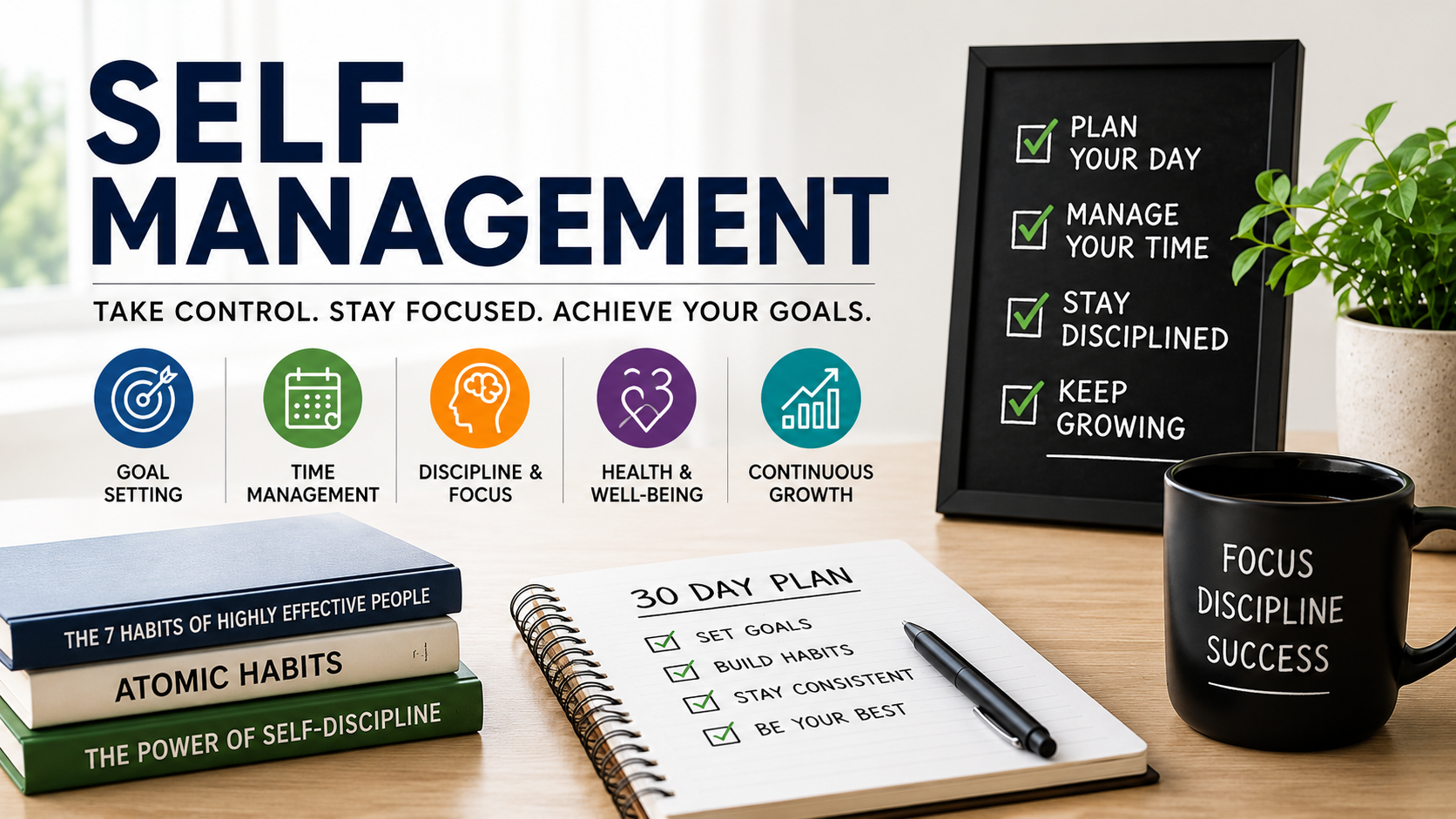
Most people don’t struggle with self management because they lack ambition. They struggle because nobody ever taught them how to build the habits, the headspace, and the physical environment that make discipline feel automatic rather than exhausting.
The good news is that self management isn’t a personality trait you’re born with. It’s a skill, and like any skill, it responds to a structured, consistent plan. Over the next 30 days, you’ll build a simple daily rhythm, borrow wisdom from some of the top rated leadership books, and set up a home workspace that quietly supports every good decision you make.
What Self Management Really Means (and Why 30 Days Works)
Self management is the ongoing practice of directing your own thoughts, emotions, time and behaviour towards the goals that actually matter to you, rather than reacting to whatever feels urgent in the moment. It sits at the heart of every leadership skill, from decision-making to communication, because you can’t manage a team, a household, or a project if you can’t first manage yourself.
Thirty days is long enough to break old patterns and short enough to stay realistic. Research on habit formation generally points to somewhere between three and eight weeks for a new behaviour to feel natural, so a focused month gives you a genuine head start without setting an impossible bar.
The Five Pillars of Self Management
Rather than trying to overhaul your entire life at once, it helps to break self management down into five manageable pillars. Work on all five gradually, and the whole system starts reinforcing itself.
| Pillar | What It Covers | Quick Win |
| Time Management | Planning, prioritising, avoiding drift | Use a single daily to-do list, capped at five items |
| Emotional Control | Staying level-headed under pressure | Name the feeling before you act on it |
| Energy Management | Protecting focus and stamina | Match hard tasks to your natural peak hours |
| Environment Design | Making your space work for you, not against you | Keep your desk clear of anything not in daily use |
| Accountability | Reviewing progress honestly | Do a five-minute Sunday check-in every week |
1. Time Management
This is the most familiar pillar, but also the one people over-complicate. You don’t need a colour-coded calendar with forty categories. You need clarity on what matters today and the discipline to protect that time.
- Write tomorrow’s top three priorities before you finish work today
- Batch small tasks (emails, admin) into one block instead of scattering them
- Protect at least one distraction-free hour for deep work
2. Emotional Regulation
Good self management means responding rather than reacting. A short pause between a trigger and your response is often the difference between a considered decision and a regret.
- Notice the physical signs of stress before they escalate
- Give yourself a fixed pause, even ten seconds, before replying to anything tense
- Keep a short evening journal to process the day rather than carrying it into tomorrow
3. Energy Management
Time is finite, but energy is renewable, and it’s the resource most people ignore. Scheduling difficult work during your natural low-energy hours is a quiet form of self-sabotage.
4. Environment Design
Your surroundings either support your habits or quietly undermine them. A cluttered desk, an uncomfortable chair, or a workspace that doubles as a dumping ground for post is a daily drag on your focus, and it’s one of the easiest pillars to fix.
5. Accountability
Self management without review is just guesswork. A brief, honest weekly check-in keeps you adjusting the plan instead of abandoning it the moment life gets busy.

Why Your Workspace Shapes Your Self Management
It’s tempting to treat self management as a purely mental exercise, but your physical environment does a surprising amount of the work for you. A desk that wobbles, a chair that leaves your back aching by 3pm, or a home office with nowhere to put paperwork all quietly chip away at your ability to focus and follow through.
A few practical upgrades worth considering as part of your 30-day reset:
- A proper desk, sized for your space, so work has one defined home rather than spreading across the kitchen table
- An ergonomic chair that supports good posture during long focus blocks
- Closed storage or a filing cabinet to keep paperwork and distractions out of sight
- Good task lighting, positioned to reduce eye strain during evening reading or planning
- A small, comfortable reading corner for the leadership books that will reinforce everything you’re learning this month
None of this needs to be expensive or elaborate. The goal is simply a space that signals “this is where I focus” the moment you sit down.
Top Rated Leadership Books to Support Your Self Management Journey
Books won’t do the habit-building for you, but the right ones give you language, frameworks and honest examples that make the daily practice easier to stick to. If you’re looking to go deeper than a single blog post can take you, it’s worth building a small shelf of top rated leadership books that you actually return to, rather than ones that simply look good unread.
One book worth starting with is Leadership Lessons and You: From A to Z, which works through leadership and self management principles in short, practical entries you can absorb a few minutes at a time, an approach that fits naturally into the 30-day plan above.
When you’re choosing top rated leadership books for your own shelf, look for titles that cover:
- Self-awareness and emotional intelligence
- Decision-making under pressure
- Communication and delegation
4.Habit formation and personal discipline
- Real, specific examples rather than only theory
You can browse the full collection, including Leadership Lessons and You: From A to Z, directly on Leadership Lessons and You to find a title that matches where you are in your self management journey.
Expert Tips for Staying Consistent
A few small adjustments make the difference between a plan that fizzles out by day ten and one that actually sticks.
Tip 1: Stack, Don’t Add
Attach new habits to routines you already have, such as journalling straight after your evening coffee, rather than inventing an entirely new slot in your day.
Tip 2: Review Weekly, Not Daily
Judging yourself every single day is exhausting and often inaccurate. A weekly review gives you enough distance to see genuine patterns.
Tip 3: Design for Your Worst Day, Not Your Best
Plan a minimum version of each habit, such as a two-minute journal entry instead of ten, so a bad day doesn’t derail the whole month.
Tip 4: Keep the Environment Consistent
Sitting in the same spot, at the same desk, for focused work trains your brain to switch into gear faster each time you sit down.

Common Mistakes That Derail Self Management
- Trying to fix all five pillars in week one instead of layering them gradually
- Measuring success by perfection rather than consistency
- Working from a cluttered, uncomfortable space and blaming a lack of willpower
- Skipping the weekly review, so small problems go unnoticed until they’re big ones
- Reading leadership books passively instead of applying one idea at a time
Frequently Asked Questions
What is self management, in simple terms?
Self management is the ability to control your own behaviour, emotions and time in order to work towards your goals, rather than being pulled around by distractions, moods or other people’s priorities. It’s a practical, learnable skill rather than a fixed personality trait.
Can you really improve self management in just 30 days?
You won’t master it completely in a month, but 30 focused days is enough to build the core habits, such as daily planning, a short evening review and a distraction-free workspace, that make ongoing improvement far easier.
What are the key skills involved in self management?
The main skills are time management, emotional regulation, energy management, environment design and honest self-review. Most people are naturally strong in one or two areas and weaker in the others, which is why a structured plan helps.
How does my workspace affect self management?
A cluttered or uncomfortable workspace adds friction to every task, making it easier to procrastinate. A dedicated, well-organised desk and a supportive chair reduce that friction and make focused work the path of least resistance.
What are some top rated leadership books to start with?
A good starting point is Leadership Lessons and You: From A to Z, which breaks leadership and self management down into short, digestible lessons. From there, look for books that balance practical frameworks with real examples, rather than theory alone.
How do I stay accountable after the 30 days are over?
Keep the weekly review going, even briefly, and revisit one leadership book chapter or self management principle each week so the habits don’t quietly fade once the initial structure disappears.
Conclusion
Self management isn’t about becoming a different person in 30 days. It’s about removing the small daily frictions, mental and physical, that make discipline harder than it needs to be. Build your habits gradually across the five pillars, set up a workspace that works with you rather than against you, and keep a book or two nearby to reinforce what you’re learning.
By day 30, you won’t just have followed a plan. You’ll have built a system you can keep using long after the month is over.
One Comment
Comments are closed.